


Learning to tell time: discovering together how time works
At ReplayClub, we often hear it from parents in our community.
“My child sees clocks everywhere, but doesn’t understand what time it is yet.“
Or, “We do practice, but it soon feels like school.”
And honest? We recognize that. Learning to tell the time is not an easy step for many children. Not because they can’t do it, but because time is something abstract. You can’t hold it, can’t see it, can’t pause for a moment.
That’s why at ReplayClub we believe that learning to tell the time is not something you teach, but something you discover together. At your pace. With room to try, err and revisit.
Why learning to tell time is difficult for many children
For us, clocking feels logical. We’ve been doing it for years.
For children, it’s a puzzle involving a lot going on at once: numbers, hands and the idea that time always goes on.
That’s why you sometimes hear things like:
“It’s five to a quarter past one.”
It may not sound quite right, but it does show that your child is thinking about time. And that’s exactly where learning to tell time begins.

Time begins not with the clock, but with feeling
In our community, we often get the question, “When is my child ready?“
The honest answer: that moment is different for every child.
For young children, time consists mostly of moments:
-
after breakfast
-
before bed
-
after school
By putting words to this, the sense of time grows naturally.
“Soon, after dinner, we’ll go outside.”
“After this story, it’s bedtime.”
Only when time becomes meaningful does a clock become interesting.
How children learn to tell time (and why it's a step-by-step process)
Learning to tell the time does not happen overnight. In school, it is spread out over several years, and for good reason. Each step requires a new understanding.
First it is about time awareness. Then whole hours. Then half hours, quarters and finally minutes. And only later comes planning and time understanding.
This also means: it is completely normal if your child already understands one thing and not yet another.
Why analog clocking is so helpful
Although children mostly see digital clocks, learning to tell time often begins with an analog clock. And that makes sense. An analog clock shows that time moves. The hands make time visible.
Children see:
-
That the little pointer is slowly advancing
-
That the big hand goes around
-
That time does not suddenly shift, but passes
That insight helps tremendously in understanding time.
Playful practice, with no school spirit
What we often hear back from the ReplayClub community: exercise works best when it doesn’t feel like exercise.
Not: “What time is it?“
But do:
-
“Shall we set the clock to dinner time together?”
-
“What time are we going to bed later, can you show us?”
That way, clocking becomes part of the day, not something that “has to be done.
Tools that really help
Not every child learns the same way. Some children benefit from something tangible. Something they get to hold, turn and try out.
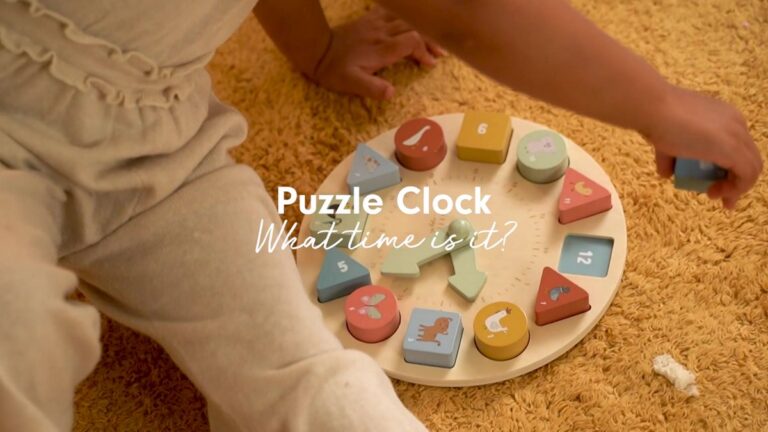
The wooden clock from Little Dutch is a great example of this. Quiet, uncluttered and made for discovery. No bright stimuli, but space to try.
At ReplayClub, you can simply borrow this clock. That way you can discover together if this suits your child, without having to buy anything right away.
When is your child ready?
Often a child shows himself when he is ready:
-
by asking questions about what time it is
-
By asking how long something will take
-
By showing interest in appointments and routines
Some children are ready for this earlier than others. And that’s totally okay.
Why borrowing toys fits so well with learning to tell the time
At ReplayClub, we believe that toys should move with your child’s development. By borrowing toys:
-
you can try without pressure
-
Change easily if something is still too difficult
-
connect the toy to where your child is right now
Practice clocking today, discover something else tomorrow.
Learning to tell the time, together and at your pace
Learning to tell the time is not a race. It doesn’t have to be perfect and it doesn’t have to be fast. It may be quiet, playful and sometimes a little messy.
And often it suddenly happens all by itself.
That moment when you ask, “What time is it anyway?“
And your child looks … and the answer is right. 💛♻️
Durable play fun
By borrowing toys instead of buying them, you not only save money and space, but also choose a more sustainable way to play. Less stuff, more fun – that’s what ReplayClub stands for.
👉 Discover the Little Dutch children’s clock and let your child playfully discover how time works.